
Editorial
How resilient is our society in a world of multiple crises? What role do energy supply, technological dependencies, and military capabilities play in our security? And how are new conflict zones, from space to the Arctic, changing Europe’s geopolitical landscape?
In a tense global climate, we would like to provide you with insight into the agenda of international think tanks and highlight emerging trends, potential threats, and areas where conflicts may arise. Recent studies show that security today is far more than just defense policy. It arises from the interplay between the state, the economy, and society, and is increasingly becoming a matter of comprehensive resilience. At the Konrad-Adenauer-Stiftung, we are actively engaged in this debate. For us, security and resilience are not abstract issues, but political responsibilities. Those who wish to preserve freedom must reduce dependencies, build resilience, and strengthen social responsibility.
Simply identifying threats is not enough. We are working on solutions. In Germany, in Europe, and globally.
More Than Disinformation: AI as Infrastructure and Autonomous Actor
Why Germany Must Adapt Its Response to Hybrid Threats
For a long time, discussions regarding disinformation and AI focused primarily on deepfakes and social media bots. However, the study KI und hybride Bedrohungen 2.0 – Warum Deutschland jetzt handeln muss, published by the German Council on Foreign Relations (DGAP), reveals that AI does more than just accelerate disinformation campaigns; it is increasingly becoming the very infrastructure through which people seek information. This creates a new threat landscape: while the focus was previously on manipulating specific pieces of content, we are now dealing with the shaping of entire information environments. Which content is displayed? How is information weighted, and what is omitted?
For a long time, discussions regarding disinformation and AI focused primarily on deepfakes and social media bots. However, the study KI und hybride Bedrohungen 2.0 – Warum Deutschland jetzt handeln muss, published by the German Council on Foreign Relations (DGAP), reveals that AI does more than just accelerate disinformation campaigns; it is increasingly becoming the very infrastructure through which people seek information. This creates a new threat landscape: while the focus was previously on manipulating specific pieces of content, we are now dealing with the shaping of entire information environments. Which content is displayed? How is information weighted, and what is omitted?
Those who control these systems can therefore not only dictate what people see but also influence their perspectives on society and politics. Autonomous AI agents present an even more critical issue: these systems build long-term personal relationships with their users and can subtly influence their attitudes and behaviour. Crucially, there is neither a unified message nor a clearly identifiable sender. Existing control mechanisms are incapable of detecting or tracing this type of influence. Furthermore, the views that emerge from these close, dependency-based relationships are often difficult to reverse.
The study thus serves, above all, as a wake-up call for security policy: in the age of AI, Germany must recognise hybrid threats as a permanent reality. Protecting democracy and social cohesion therefore requires proactive action involving a range of measure, such as collaborations with the academic community in the form of research funding for comprehensive monitoring, as well as various labelling and transparency requirements. The state must by no means wait until manipulation becomes visible before reacting; by then, the damage would already be irreversible.
Further information on this topic can be found in the Chatham House study Holding state-sponsored hackers and other cyber proxies to account (2026) and the Aspen Institute study Hybrid Realities: Disinformation, Influencers, and the Defense of Democracy in Central and Eastern Europe (2025).
Those who control these systems can therefore not only dictate what people see but also influence their perspectives on society and politics. Autonomous AI agents present an even more critical issue: these systems build long-term personal relationships with their users and can subtly influence their attitudes and behaviour. Crucially, there is neither a unified message nor a clearly identifiable sender. Existing control mechanisms are incapable of detecting or tracing this type of influence. Furthermore, the views that emerge from these close, dependency-based relationships are often difficult to reverse.
The study thus serves, above all, as a wake-up call for security policy: in the age of AI, Germany must recognise hybrid threats as a permanent reality. Protecting democracy and social cohesion therefore requires proactive action involving a range of measure, such as collaborations with the academic community in the form of research funding for comprehensive monitoring, as well as various labelling and transparency requirements. The state must by no means wait until manipulation becomes visible before reacting; by then, the damage would already be irreversible.
Further information on this topic can be found in the Chatham House study Holding state-sponsored hackers and other cyber proxies to account (2026) and the Aspen Institute study Hybrid Realities: Disinformation, Influencers, and the Defense of Democracy in Central and Eastern Europe (2025).
Social Resilience: Measuring What Really Matters
Is Germany prepared?
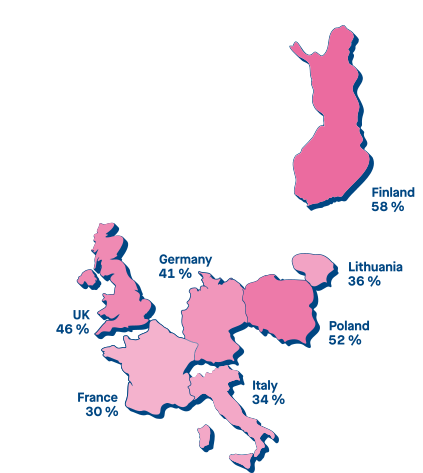
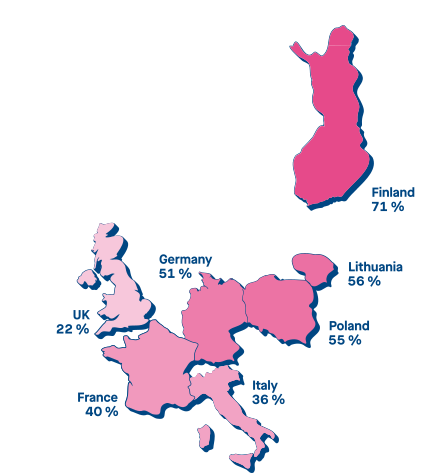
How resilient are Europe and Germany in a crisis? Today, resilience is no longer measured solely in terms of military strength. In an era shaped by artificial intelligence, disinformation, and economic dependencies, resilience has become a task for society as a whole. The National Security & Resilience Index (NSRI), developed by PwC and the German Council on Foreign Relations (DGAP), presents for the first time an index that makes it possible to measure a state’s resilience across several dimensions.
The NSRI does not merely assess indicators such as defence spending, troop strength, or military equipment. Rather, it examines how effectively military capabilities, industrial capacity, and civilian resilience interact. For Germany, the findings are ambivalent. On the one hand, the country has a strong economic foundation, a capable industrial base, and significant military personnel potential. On the other hand, the study identifies critical bottlenecks, including dependence on energy imports, operational readiness, procurement processes, societal mobilisation, and data gaps.
The index particularly emphasises that military strength cannot compensate for civilian vulnerability; industrial capacity remains ineffective if supply chains, emergency plans, and societal acceptance are lacking. In this respect, the NSRI touches on a highly relevant issue: energy security, energy independence, defence capability, and societal mobilisation can no longer be treated as separate policy fields. Instead, resilience must be understood as a networked concept that spans all actors within a state. The NSRI highlights vulnerabilities and explains why security will no longer be determined solely on military bases, but also in power grids, supply chains, public administrations, companies, and households.
How can resilience be implemented in concrete terms and how far has Europe come in this regard? In its commentary All hands on deck (2025), the Casimir Pulaski Foundation uses the Baltic Sea region to illustrate how civil and state preparedness is organised within the framework of “Total Defence”. The research paper Civil defence in Europe (2026) by the International Institute for Strategic Studies complements this perspective with a comparative analysis that highlights where European states currently stand and where gaps remain.
The New Gas Shock
Saving Energy Instead of Capping Prices
EU Gas Imports 2025
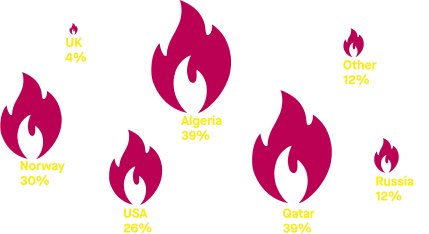
The war against Iran and the closure of the Strait of Hormuz have caused turmoil in global energy markets. However, a study by the think tank Bruegel, titled How Europe should respond to the Iran gas shock – and how it shouldn’t, does not view this as a repeat of the 2022 gas crisis that followed the start of Russia’s war of aggression against Ukraine. While approximately 20 percent of global LNG, mostly from Qatar, passes through the Strait of Hormuz, LNG shipments from Qatar account for only about eight percent of the EU’s total LNG imports. Consequently, the EU’s gas supply is not immediately threatened by the closure of the Strait of Hormuz. According to the study, the real risk lies in intensified competition, particularly with Asia, for LNG supplies from the US that are not affected by the disruption. The resulting price increases could place a massive burden on both households and industry.
The study warns against overly simplistic solutions: blanket price caps, broad-based subsidies, or even a return to Russian gas, with the associated dependency, should be rejected. Instead of artificially lowering prices, the authors advocate a pragmatic approach: gas storage facilities must be filled in good time, gas consumption significantly reduced during winter, and demand better coordinated. Targeted relief measures should be reserved for vulnerable groups. In the short term, there could be increased reliance on coal-fired power plants; however, in the medium to long term, the deployment of heat pumps and renewable energy sources must be accelerated to reduce dependence on fossil fuels and avoid future price shocks.
Answers to the question of how Asia is responding to the gas price shock can be found in the ERIA study: From Shock to Strategy: Strengthening ASEAN Energy Security and Economic Resilience after the Strait of Hormuz Disruption (2026).
When Data Becomes Ammunition
What Ukraine Reveals About the Future of Warfare
How many soldiers are needed to defend a mile (approximately 1.6 kilometres) of the front line? In Napoleon’s time, up to 20,000 men were required. In Ukraine, as few as 64 to 96 soldiers are can sometimes hold the same stretch of front line. This is made possible by a battlefield monitored almost continuously with the help of drones. Yet the real transformation extends far beyond the deployment of new weapons systems: data is increasingly becoming a strategic resource that is collected, analysed and converted into military effect.
The Hudson Institute study Ukraine’s Drone War: The Rise of Machine-Speed Adaptive Hyperwar illustrates how Ukraine is holding its own against numerically superior Russian forces using low-cost aerial, ground, and maritime drones. However, the study is about far more than unmanned systems alone. The authors describe how drones, sensors, software and AI are merging into integrated battle networks that significantly accelerate military decision-making and operations. Data generated during operations is becoming a strategic resource. Ukraine possesses a unique repository of imagery, targeting, and sensor data that can be used to train AI systems for target acquisition, artillery correction, electronic warfare and manoeuvre planning.
NATO must draw lessons from these findings. It requires more affordable counter-drone systems to reduce the cost asymmetry between cheap attack drones and costly interceptor missiles. Shorter innovation cycles are equally necessary: Western weapons systems often take between 10 and 20 years to develop, far too slow for modern warfare. Finally, the Alliance must reduce its dependence on China. According to the report, the country controls 80 to 90 percent of the global drone market. Key raw materials and components, ranging from battery cells to motors and sensors, originate from Chinese-dominated supply chains. Virtually all drone systems used in Ukraine contain Chinese materials or components. This poses a significant strategic risk.
Furthermore, the situation in Ukraine makes it clear that modern conflicts are no longer decided solely on the battlefield. Alongside drones and digital battle networks, cyberattacks, sabotage and other hybrid methods are becoming increasingly important.
We therefore recommend looking at: The Everywhere War- Sub-Threshold Warfare Tracker. It provides an ongoing overview of military provocations, cyberattacks, acts of sabotage, and other hybrid operations conducted by Russia against European states.
Germany Looks North
Why the Arctic Is Gaining Significance for Security Policy
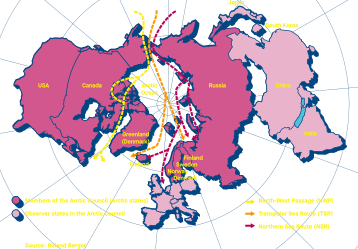
In recent years, the Arctic has primarily been viewed through the lens of climate and environmental research; images of melting polar ice caps have served as a prime example of the consequences of global warming. Yet, as the ice recedes, the region’s strategic importance grows: coveted raw materials lie beneath the ice, and new shipping routes are coming within reach, bringing with them the interest of major powers. The study Deutschland als arktischer Sicherheitsakteur: Neue Leitlinien deutscher Arktispolitik unter schwierigeren Bedingungen, published by the German Institute for International and Security Affairs (SWP), makes it clear: Germany can no longer treat the Arctic as a remote backwater of global politics.
As an export-oriented nation, Germany relies on stable supply chains and secure maritime routes underpinned by a rules-based order. Furthermore, Arctic raw materials, such as lithium, nickel, and cobalt, offer opportunities for diversification, thereby helping to reduce dependency on China. Although the government defined guidelines for German Arctic policy for the first time in 2024, the authors argue that these remain too vague in key areas. While Germany commits to the principles of a rules-based order and the goal of security and stability in the Arctic, it lacks a clear vision of how these objectives are to be achieved in practice. These guidelines must therefore evolve into a clear strategy featuring defined priorities, resource management, and a realistic assessment of the altered security landscape.
Going forward, Germany must actively represent its interests in the Arctic and assert them using political, economic, and security-related instruments. This requires closer coordination with the EU and NATO, while the changing relationship with the US under Donald Trump should also be taken into account in the new Arctic strategy.
More information on Russia’s role and the potential for conflict in the Arctic can be found in the RAND study: Russia in the High North: Russian Strategy and Escalation Risks in the High North After the Russia-Ukraine War | RAND (2026).
New Trade Routes
The War of the Satellites
A Vision of the Future – or Already a Reality?

As technological progress accelerates, outer space is increasingly becoming a focal point of global tensions. Since the Moon landing in 1969, this progress has been immense. The computing power of a modern iPhone is slightly more than a million times greater than that of the Apollo Guidance Computer (AGC) used in the Apollo 11 mission. It is therefore hardly surprising that the ability to conduct missions in space is becoming indispensable on the “battlefield” of the future. Satellites ensure central functions of modern societies, including communication, navigation, weather data, military reconnaissance, and command and control. Precisely for this reason, so-called counterspace capabilities are attracting growing attention: capabilities that enable states to detect, disrupt, blind, or even destroy space systems.
The latest report by the Secure World Foundation, Global Counterspace Capabilities 2026, examines how 13 states (including the United States, Russia, China, and India) are expanding their military space capabilities. The findings show that the race in space is accelerating. Although current conflicts have so far primarily involved non-destructive means such as electronic interference and cyber operations, research, testing, and military concepts are developing at a rapid pace. The report points, among other things, to growing interest in “bodyguard” satellites, Chinese experiments in orbit, Russian rendezvous and proximity operations, new US doctrines on dynamic space operations, and a marked increase in jamming and spoofing in conflict regions.
Technological progress is intersecting with a fragile international security order and a comparatively thin regulatory framework for outer space. The Outer Space Treaty of 1967 remains the foundation of space law to this day; in particular, it prohibits the stationing of nuclear weapons and other weapons of mass destruction in orbit, but it does not prohibit all military uses of outer space. The Global Counterspace Capabilities report makes visible which operations in space are already possible today and why the next security-policy crisis may not begin on Earth, but above it.
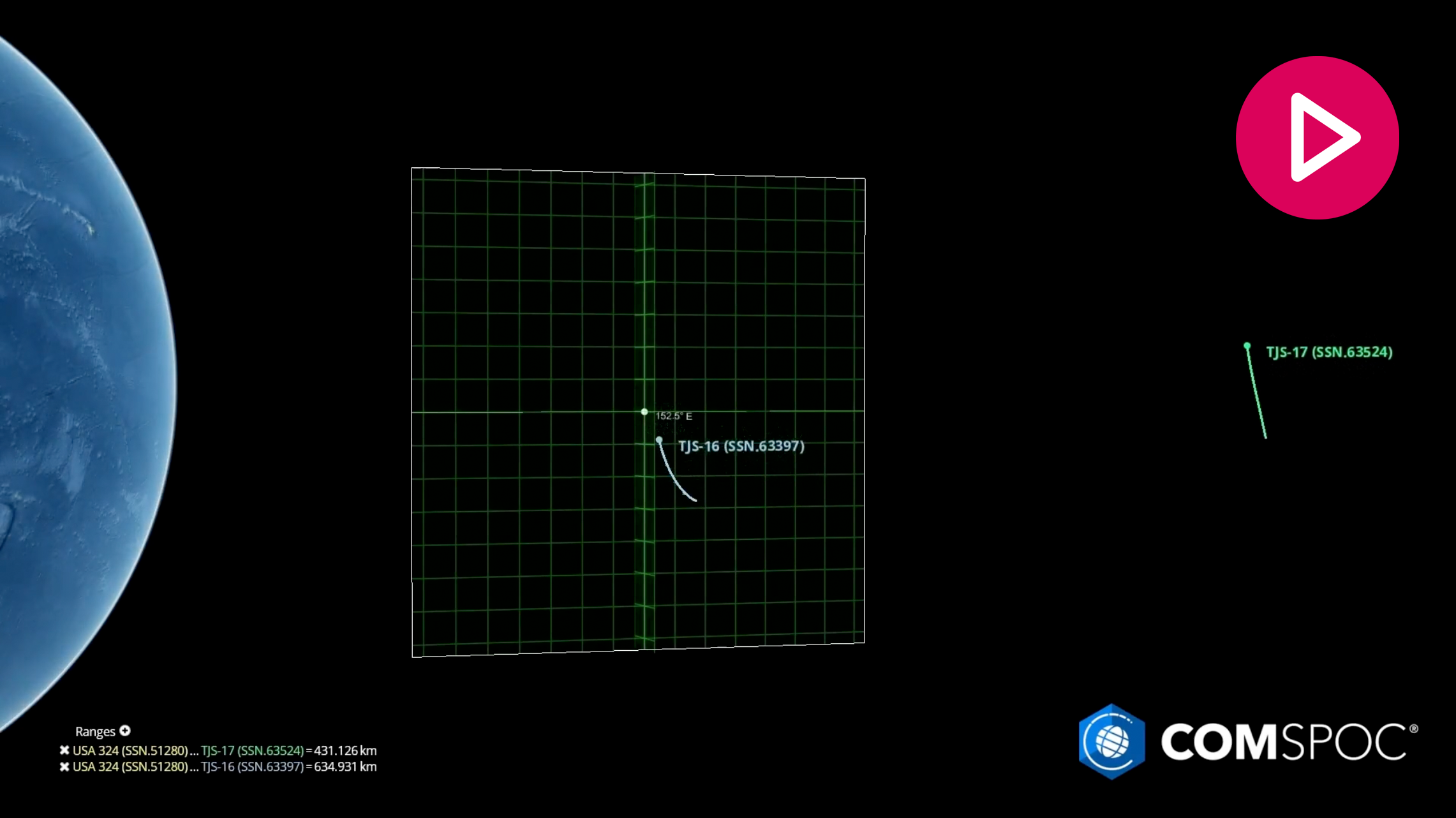
The growing tensions in outer space became evident in April 2025 through the encounter between the American surveillance satellite USA 324 and the Chinese satellites TJS-16 and TJS-17. As part of a so-called rendezvous and proximity operation, the US satellite approached the Chinese systems to analyse their characteristics and capabilities at close range. The incident illustrates how outer space is increasingly becoming an arena of strategic competition between major powers. Similar developments in the European context are discussed in the RAND commentary How Russia Is Intercepting Communications from European Satellites (2026).

© Konrad-Adenauer-Stiftung e. V. 2026
Contributors to this issue:
Team KALUZA + SCHMID Studio, Leander Apel, Bogdan Miftakhov, Katja Plate, Philipp Schmitt, Sophie Steybe
Sources
(1) Muñoz, Katja (2026): KI und hybride Bedrohungen 2.0, Deutsche Gesellschaft für Auswärtige Politik e. V., Berlin.
(2) Behne, Paul Malte & Florian Andresen (2026): Measuring What Matters – Introducing the National Security & Resilience Index (NSRI), PWC, Frankfurt am Main.
(3) Keliauskaitė, Ugnė et al. (2026): How Europe should respond to the Iran gas shock – and how it shouldn’t, Bruegel, Brüssel.
(4) Burstedde, Alexander & Paula Risius & Hubertus Bardt (2025): Wehrpflichtsdebatte: Attraktivität der Bundeswehr entscheidend, Institut der deutschen Wirtschaft, Köln.
(5) Adrians, Helge et al. (2025): Deutschland als arktischer Sicherheitsakteur, Stiftung Wissenschaft und Politik,, Berlin
(6) Samson, Victoria & Kathleen Brett (2026): 2026 Global Counterspace Capabilities Report, Secure World Foundation, Washington, DC.